The Three Laws

When you enter my office, one of the first things that you’ll see are each of “Donaldson’s Laws” hanging on the wall. The laws are three simple edicts that I share often with my workmates and that I repeat regularly. So, why three laws? Honestly, the laws developed over time, and I’ve found that I do not need any more than these. Three is an easy number to remember, and people that work with me know exactly what I’m saying when I reply, “You know that you’re breaking law number two”.

When I started my first job as an engineer, my boss provided me with a list of requirements that was no less than 25 guidelines, many of which (to me) were simple common sense. Even at that point in my career, I remember wondering how many of the items on the list I could remember. Ultimately, a few of the items on the long list resonated with me, and those became the handful that were committed to memory.

So, what’s the impact of the three laws? I believe in each law, and they are at the core of how I’ve functioned as a professional. They transcend professions and have been applicable at every stage of my career. I’ve found that if I am obedient to the laws, and really embrace their intent, then the majority of the everyday problems that I encounter are mitigated.

Law 1: Expectation Drives Behavior – How often have you been disappointed by a deliverable or the behavior of one of your team members? Time and time again, my experiences have driven home the point that people mis-understood or mis-interpreted what was expected. “Oh, I didn’t know that’s what you meant”, or “I thought that I understood the deliverables” was a common response that I’ve heard more than once. Whether it applies to annual goals or regular assignments, the answer is to over-communicate what your expectations are and be clear and deliberate in ensuring that your team or organization understands. Quantify your expectations, put them in writing, and make them measurable. You’re not going to hurt anybody’s feelings; quite the opposite… your team will respect you more for providing necessary vision and direction from the start. Communicate your expectations and check for confirmation.
Law 2: Don’t feed the Stray Cat – When I was a child, a random cat showed up on our family’s doorstep one afternoon. The thing was friendly and a bit mis-kept as should be expected. My brothers and I gave the cat a name, played with it for a short while, and then (as kids have been known to do) brought it food and drink. When the summer sun dipped below the horizon, we picked up our baseball gear and headed inside. And the next day when we came out to play baseball in the yard, who would you imagine was there to greet us? A week later, the cat moved into the garage.
In the workplace, that same stray shows up every day. That situation where you take on a task when the responsible party has not done it?… Hello, you’ve just fed the stray cat. The meeting where you accept the customer’s excuses for not providing necessary requirements?… Yup, you’ve done it again. When you reluctantly follow the out-dated company process and do nothing to make it better?… You guessed it. The problem is that when you’re feeding the stray cat, it feels like the right thing to do, or should I say that it feels like what is required. If Joe doesn’t get this done, then the whole team will look bad, so I better do it for him. It isn’t until that cat moves into the garage, that you realize the implications. What happens the next time that Joe gets a critical assignment? Joe has no ownership of the task at hand because he knows that you’ll feed the cat.
The solution is to deal with the stray cat when it first shows up by taking the heel of your boot and bringing it down on the creature’s head with bone crushing force… repeatedly if necessary, until you are certain that it is dead.
Law 3: Alert the Tower at 10,000 Feet – Let’s think of our program or company as a commercial air liner and the leadership as the pilots. Healthy organizations empower competent professionals (insert engineer, sales, manager) that display a healthy confidence in themselves and their teams. This is exactly what you want in your company, but how do we deal with overconfidence?
So here we are in our jet traveling to our destination. Lights begin to flash in the cockpit at 20,000 feet and the team calmly goes into action to fix the problem. The problem persists and the pilot and flight crew continue their efforts to identify the root cause while the plane. Unable to maintain altitude, the plane descends to 10,000 feet. At this point, the situation may get some additional visibility within the organization (The Flight Tower), but the pilot reassures the tower that the flight crew has things under control, and they will right the situation.
As the plane falls below 1,000 feet, the pilot realizes that the ground is approaching quickly and contacts the tower to communicate the seriousness of the problem. The flight crew needs help. By the time the tower gathers the appropriate resources, the plane reaches the 100 foot mark, and the pilot is doing everything possible to avoid impact. I think that you know what happens next.
Our story highlights the importance of communicating to the tower. This comes in steps that escalate the issue, first on the plane and then to the tower.
  1. Issue Identificaiton: All hands on deck within the project team – identify the root cause, action plan and expected completion
  2. 20,000 feet: “Houston, we have a problem”… Management visibility: here’s what the issue is, what we are doing, and when it will be resolved.
  3. 10,000 feet: There are hurdles preventing the team from resolving the issue. Immediate management involvement is required to address the problem. (with adequate time to affect a proper solution)
Escalation is viewed as a weakness or failure by many organizations which is disappointing. The challenge is to encourage the team to share the information amongst themselves, and then with each successive level of management. Unfortunately, the confident leader is thinking that they will be able to fix the problem as the plane gets ever closer to the ground, and in many cases, asks for help when very little can be done to avoid the collision. Escalating from visibility to support and then holding management accountable for delivering on their commitment of support will in time change the culture of the organization.

These are my three laws… I’d encourage you to identify yours and be intentional in how you apply them.

Posted in Career, Leadership, Management | Tagged , | 1 Comment

Your Inner Demon


In the 1987 movie Wallstreet, Gordon Gekko offered the phrase, “Greed is Good”. Greed is what drove this fictional character to achieve his personal goals, and although I don’t subscribe to Gekko’s mantra, I do think that there are things that people generally see as BAD, that I would consider GOOD.

What I’m asking you to do right now, is to think about what your every day motivation is. That thing that you resist telling others about… that thing that others may tell you is bad. Maybe it’s greed or recognition, pride or advancement, compassion or fear. For the purpose of this discussion, let’s call that thing that resides inside of you – your “inner demon“.

Be honest with yourself. Take a few minutes and think about what your inner demon is. There are varying types of inner demons, some of which are rather tame and others (like Gordon Gekko’s) that are a bit more devious. Remember that you don’t have to tell anybody… this is your little secret. But in the spirit of fair play, I’m going to introduce you to my inner demon, and I would suggest that when I refer to it, that you take the opportunity to reflect on yours.

As a general rule, I understand and embrace the fact that I walk around each day with a certain amount of rage churning inside of me. When I refer to rage, I’m not talking about anger, but a fire in my belly that pushes me to do what I do every moment of every day. Maybe a more correct description is passion, but in all honesty, that thing inside of me is not always a positive so I call it rage. My rage is there when I wake up, and it’s there when I go to sleep. Admittedly, there are days that it burns white hot, and other days when it is a slow simmer, but it never goes away. Over the years, I have dealt with my inner demon (not always effectively) and I’ve learned how to harness that energy and to use it.

I’ve worked with people that have recognized my inner demon, and have cautioned me that I need to deal with it… Possibly through therapy? I, on the other hand have come to the conclusion that they do not understand that they have their own inner demon or what it means to embrace it. I’ve come to see this as my advantage, and their loss.

My rage, as you can imagine comes in many forms:

  • the continued institutional corruption and financial status of the metropolitan area in which I live
  • the horrible movie that my wife and I went to see the previous night – two hours of my life that I will never get back
  • The fact that the Spartans managed to blow a second half lead
  • That point in the season when I realize that the Lions will once again disappoint their fans
  • Continued tolerance for a lack of accountability in the workplace

And the result of harnessing that rage results in as many outputs:
  • It drives a never-ending need for change – to address what is wrong and make it right… good enough is never good enough
  • It motivates me to interact directly with others – to ensure clarity & understanding
  • It pushes me to seek out help from my Mentors, and to mentor others
  • It feeds my determination to make myself and those around me better at what we do – to not be satisfied with the status quo
  • It serves as a reminder that although my rage fuels what I do, it isn’t what drives those around me – it ensures that I provide the appropriate feedback to my team that will motivate them

What I’m suggesting is that you sit down and be painfully honest with yourself in identifying the inner demon that motivates you. And despite all of the politically correct thinking that those around you are spouting, embrace it and use it to fuel your efforts. Easier said than done…. I know. Instead of tucking it away, find a means of using your inner demon to make you and those around you better.

It must be said that this is not something that happens over a weekend. It’s taken me much of my lifetime to get to where I’m at. Admittedly, I’m a slow learner, but the first step is to realize what that driver is and embracing it. At that point, the difficult work begins.
 
Music is one of the tools that I use to stoke the fire, and below you’ll find a link that I share with my team. It’s a list of music that I use to pick me up and get me going… I’ll often find myself listening to this while I’m working late to meet a critical deadline, or in the midst of my early morning commute. The music is hosted on a streaming site that does not require you to download any software, simply hit play and listen – maybe you’ll find something in the list of tunes that gets your motor running.


Good luck in identifying your inner demon and harnessing its energy. As always, be intentional!
Posted in Career, Leadership, Motivation | 1 Comment

Top 5 Movies

In assembling a list of my favorite movies, I take into account all of the standard considerations; writing, acting, directing, music, special effects. But the most critical aspect for me is how eager I am to watch the movie despite the fact that I may have watched it many times… Let’s get on with it.

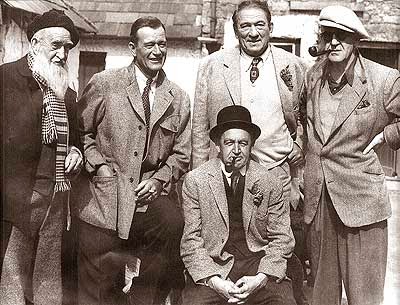
The Quiet Man (1952) – During a summer internship between my freshman and sophomore years of college I was introduced to this movie by a co-worker who was aware of my appreciation of John Wayne. He insisted that this was the best of Wayne’s movies. I fell in love with the location and direction of the film… I’m a sucker for the character actors that showed up in a number of John Wayne’s films over the years – fantastic story, great characters.

The Godfather (1972 – Admittedly, this one is on everybody’s top film lists, but each time I watch the Godfather, I feel a wave of nostalgia for a time that has moved on – this is the quintessencial film that indentifies the American experience filled with vivid characters and a story that just pulls you in.


Alien (1979) – as a child, my father took me to see Alien, and I mesmerized. was hooked for life. So many aspects of this film became an obsession for me – H.R. Giger’s artwork, the storytelling, the backstory behind the creation of the film and the creature, and an introduction to so many wonderful actors that I would follow for years: Harry Dean Stanton, Sigourney Weaver, John Hurt. As a teen ager, my brothers and I would create a haunted house each year in our parents garage, and for a number of those years, Alien was the basis for that event.


Blade Runner (1982) – as an Industrial Design student at Michigan State University, Syd Mead’s wonderful creations of a future world grabbed ahold of my attention and imagination. My affection for his artwork has remained intact as an adult. Mead’s blueprint for “scorched earth future” became the blueprint for movies over the next 30 years. A truely creative story and an exquisite attention to detail… these characters in this movie are amongst my favorites of all time.


The Blues Brothers (1980) – during High School, like many other teens, I was obsessed with John Belushi. There was a time when I would come from home from school, pop in the VHS tape, and watch this movie every single day while I did homework. In following what Belushi and Akroyd had done in creating the backstory for characters of Jake and Elwood Blues in preparation for the film, the Blues Brothers opened a new world of Blues and Rythm and Blues to me. In my opinion, this is one of the greatest musicals that Hollywood has churned out over the years.
The Rest:

Continue reading

Posted in Movies | Leave a comment

The OSM

I’ve followed Steve Farber for a couple of years now and found him to possess a mindset and sensibility that resonates with me. If you’re not familiar with Farber, then let me introduce you.

 
A subject-matter expert in business leadership and a frequent guest on news-talk shows around the country, Farber is a senior-level leadership coach and consultant who has worked with and spoken to a wide variety of organizations. Steve is the president of Extreme Leadership, Incorporated, and the founder of The Extreme Leadership Institute, organizations devoted to the cultivation and development of Extreme Leaders in the business community, non-profits and education.
 
I’d like to share one of my favorite snippets.

More about Steve Farber at stevefarber.com
Posted in Career, Leadership, Motivation | Leave a comment